
Big Bucks: Sustainable Apparel Exploration
The key to sustainability in the apparel industry is combining the Cradle-to-Cradle (C2C) design philosophy, the Twelve Principles of Green Engineering, and Zero Waste design (Gullingsrud and Perkins 2015). The C2C design philosophy promotes the circular economy of materials by recycling and repurposing discarded products (McDonough et al. 2003), and the Twelve Principles of Green Engineering provide structured guidance on how to utilize the C2C philosophy (Braungart and McDough 2009, 157–186). Big Bucks was inspired and designed with the C2C approach, while employing six of the Twelve Principles of Green Engineering (Braungart and McDough 2009, 157–186; McDonough et al. 2003).
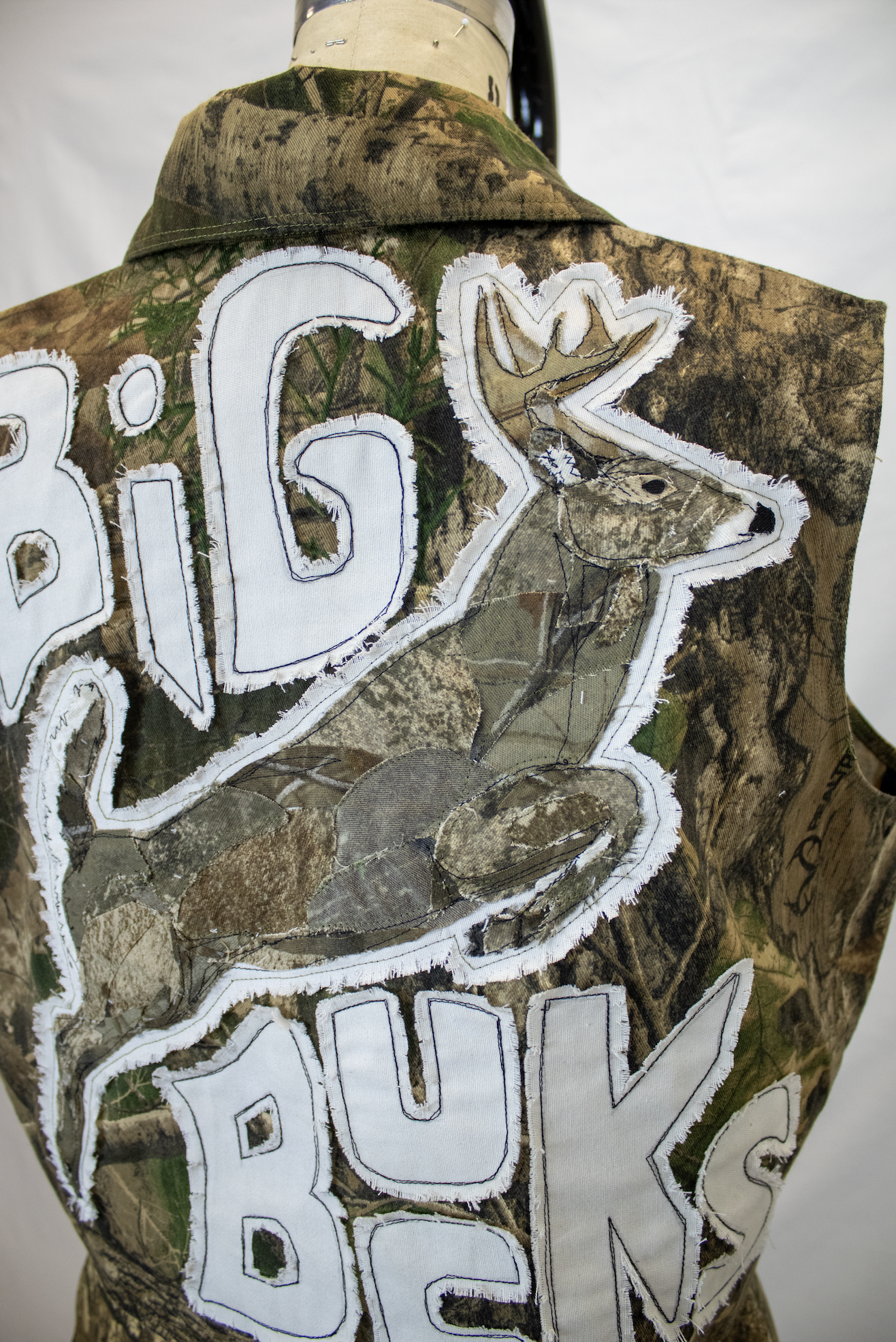
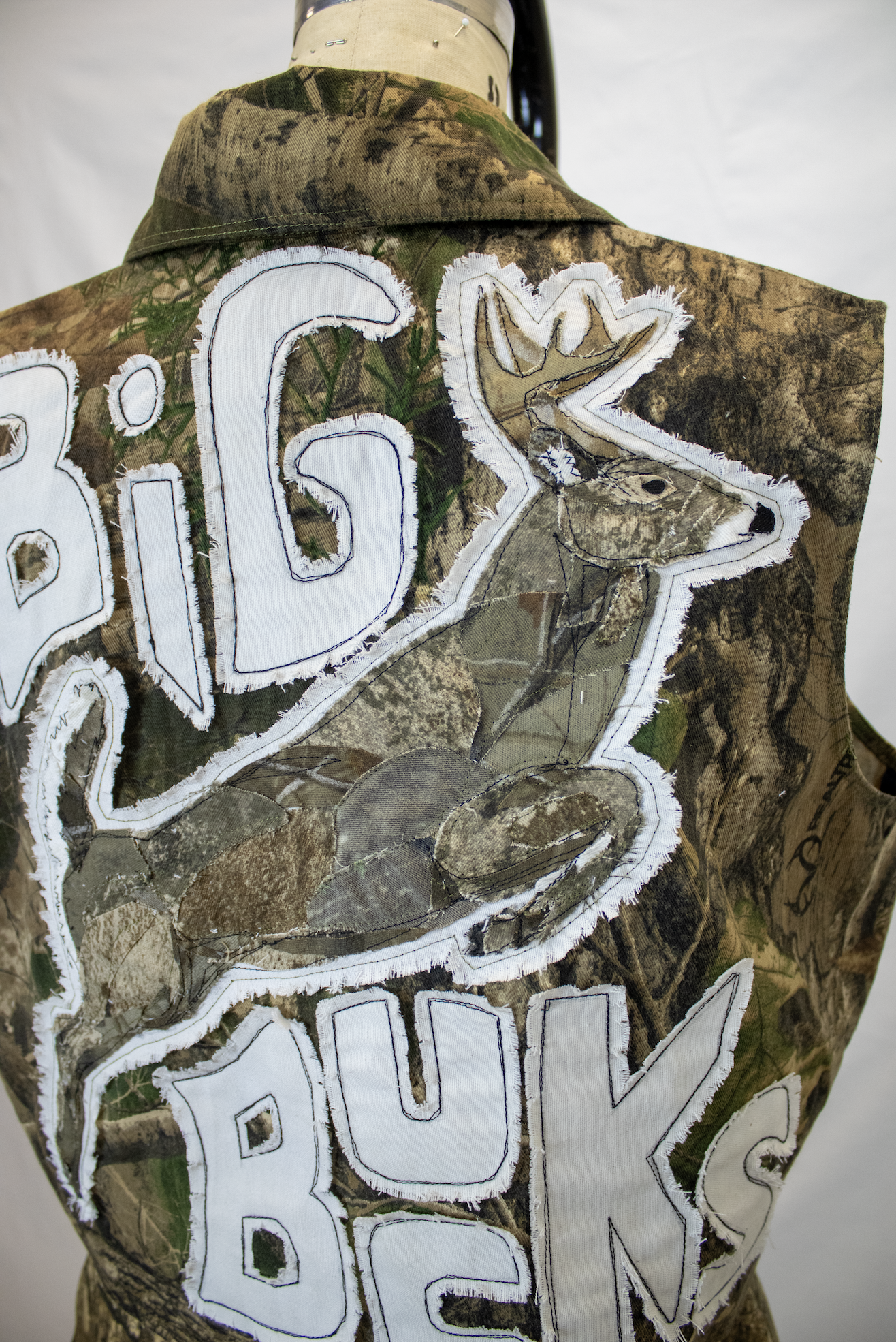
Focusing on Green Engineering Principle five, this look was designed with “output pulled” materials (McDonough et al. 2003). Industry samples and swatches of discarded camouflage cotton twill were used as the body of the garment. Each sample was 20” tall so patterning was designed intentionally, thus resulting in added horizontal seams to the pants front and back. All notions were also collected through discarded materials; therefore, no monetary investment was spent on the look leading to the addition of the patch on the back of the top. Big Bucks is a statement and play on words about the free waste used to construct the garment. The patch was constructed using scrap camouflage and cream fabrics by incorporating a Zero Waste design solution (Kamis 2018; Rissanen 2015). Following Green Engineering Principles three, seven, nine, and eleven, all fabrics in this garment are 100% cotton, resulting in ease of recycling and durability. Research has suggested cotton fabrics can be shredded and recycled into new fabrics, allowing for a circular sustainable design (Hawley 2015). Green Engineering Principle one is utilized through the overdye of fabrics with natural dye. A coffee overdye was used to create a more desirable aesthetic through a nonhazardous process (Bechtold 2023).
Big Bucks broadens sustainable design scholarship by combining the twelve Principles of Green Engineering, Cradle-to-Cradle design philosophy, Zero Waste, and natural dying methods. Adopting these principles in the design process can have major impacts on the sustainability and circularity of the garment. By utilizing sustainable initiatives, it is possible to have aesthetically pleasing statement garments that have a positive impact on the apparel industry.



References
Bechtold, Thomas, Avinash P. Manian, and Tung Pham. 2023. Handbook of Natural Colorants [Electronic Resource] / Edited by Thomas Bechtold, Avinash P. Manian, Tung Pham. Second edition. John Wiley & Sons Inc. https://research.ebsco.com/linkprocessor/plink?id=3d92f045-62f9-3787-af6fad5da9934fa9.
Braungart, Micheal, and William McDonough. 2009. Cradle-to-Cradle. Vintage.
Gullingsrud, Annie, and Lewis Perkins. 2015. “Designing for the Circular Economy: Cradle to Cradle Design.” In Sustainable Fashion: What’s Next?, edited by Janet Hethorn and Connie Ulasewicz. Bloomsbury Publishing.
Hawley, Jana. 2015. “Economic Impact of Textile and Clothing Recycling.” In Sustainable Fashion: What’s Next?, edited by Janet Hethorn and Connie Ulasewicz. Bloomsbury Publishing.
Kamis, Arasinah, Nornazira Suhairom, Rahimah Jamaluddin, Rodia Syamwil, and Farah Najwa Ahmad Puad. 2018. “Environmentally Sustainable Apparel: Recycle, Repairing and Reuse Apparel.” The International Journal of Social Sciences and Humanities Invention 5(01): 4249-4257. https://doi.org/10.18535/ijsshi/v5i1.04
McDonough, William, Micheal Braungart, Paul T. Anastas, and Julie B. Zimmerman. 2003. “Applying the Principles of Green Engineering to Cradle-to-Cradle Design.” American Chemical Society: 435 – 441.
Rissanen, Timo. 2015. “Zero Waste Fashion Design.” In Sustainable Fashion: What’s Next?, edited by Janet Hethorn and Connie Ulasewicz. Bloomsbury Publishing.